Miracles of Each Moment
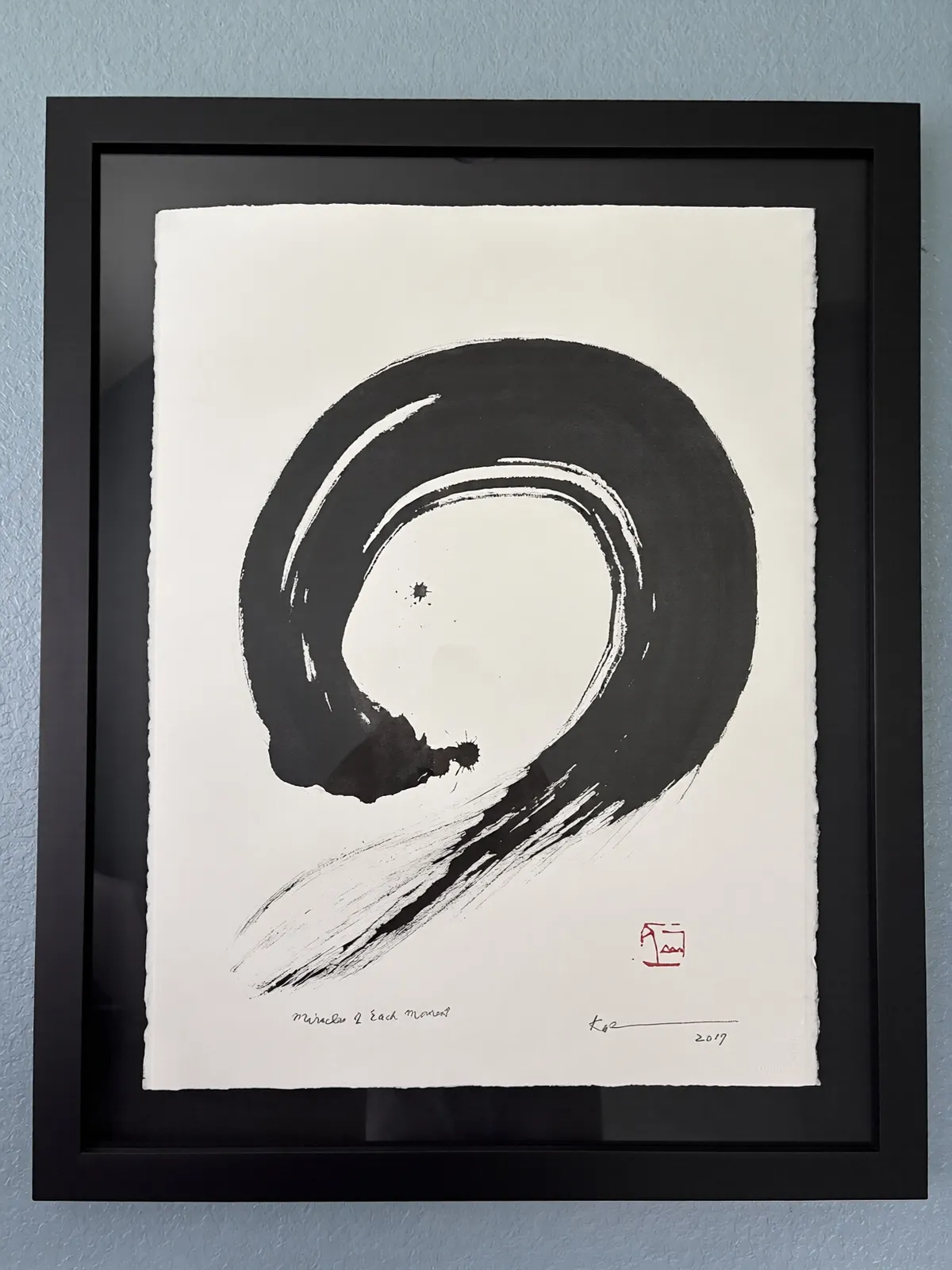
In 2017, I had the privilege of attending a calligraphy demonstration at the Houston Zen Center by none other than Kazuaki "Kaz" Tanahashi. A silent auction was held afterwards and I ended up with the piece you see here. It was my first time with proper art, so of course I took it to be framed. When I went to pick it up, I discovered how expensive that process actually is. It was more than I paid for the art itself. Lesson learned, or perhaps I was scammed, who knows?
Regardless, it has accompanied us from our first home, to multiple flats in Edinburgh, and now back to the US again. Though I no longer consider myself a Zen practitioner, I often find myself reflecting on the meaning of the ensō (円相) when it catches my eye.
You wouldn't think much could be said about an imperfect circular form. It's created by a single breath. A single, uninhibited brush stroke. In that simple act, a moment is recorded. The attitude of the artist, the weight of the brush, the speed of the stroke, the nature of the ink. In Zen circles (pun intended), it is a symbol of enlightenment, of mu-shin 無心 (no-mind), of pure, unadulterated, ego-less action.
The space inside represents sunyata, emptiness. A bit on the nose perhaps, but that is a technical term in Buddhism. The most beautiful explanation of which, in my opinion, exists in the Heart Sutra (the Prajñāpāramitāhṛdaya or The Heart of the Perfection of Wisdom Sutra):
The noble Avalokiteshvara Bodhisattva,
while practicing the deep practice of Prajnaparamita,
looked upon the five skandhas
and seeing they were empty of self-existence,
said, “Here, Shariputra,
form is emptiness, emptiness is form;
emptiness is not separate from form,
form is not separate from emptiness;
whatever is form is emptiness,
whatever is emptiness is form.
The same holds for sensation and perception,
memory and consciousness.Here, Shariputra, all dharmas are defined by emptiness
not birth or destruction, purity or defilement,
completeness or deficiency.Therefore, Shariputra, in emptiness there is no form,
no sensation, no perception, no memory and no consciousness;
no eye, no ear, no nose, no tongue, no body and no mind;
no shape, no sound, no smell, no taste, no feeling and no thought;
no element of perception, from eye to conceptual consciousness;
no causal link, from ignorance to old age and death,
and no end of causal link, from ignorance to old age and death;
no suffering, no source, no relief, no path;
no knowledge, no attainment and no non-attainment.Therefore, Shariputra, without attainment,
bodhisattvas take refuge in Prajnaparamita
and live without walls of the mind.
Without walls of the mind and thus without fears,
they see through delusions and finally nirvana.All buddhas past, present and future
also take refuge in Prajnaparamita
and realize unexcelled, perfect enlightenment.You should therefore know the great mantra of Prajnaparamita,
the mantra of great magic,
the unexcelled mantra,
the mantra equal to the unequalled,
which heals all suffering and is true, not false,
the mantra in Prajnaparamita spoken thus:
“Gate, gate, paragate, parasangate, bodhi svaha.”
Translated by Red Pine
Even today, as a Pure Land practitioner, the Heart Sutra resonates deeply. When I first embraced Jodo Shu, I found myself becoming a bit overly dogmatic, a 'practice purist'. By abandoning all other texts and practices, I thought I was honoring the Nembutsu, giving it pride of place. However, after discussions with my teacher, Rev. Taijun Kasahara of Rinkaian Temple (Tama City, Tokyo), and more time spent in contemplation, I realized I was misunderstanding Honen Shonin's point. Yes, the Nembutsu is the key to ojo, our rebirth in Amida Buddha's Pure Land, but other Dharmas are not lesser as a result.
There's value to be found in all Dharmas, even if our ultimate goal lies west.