A Fool's Take on Karma
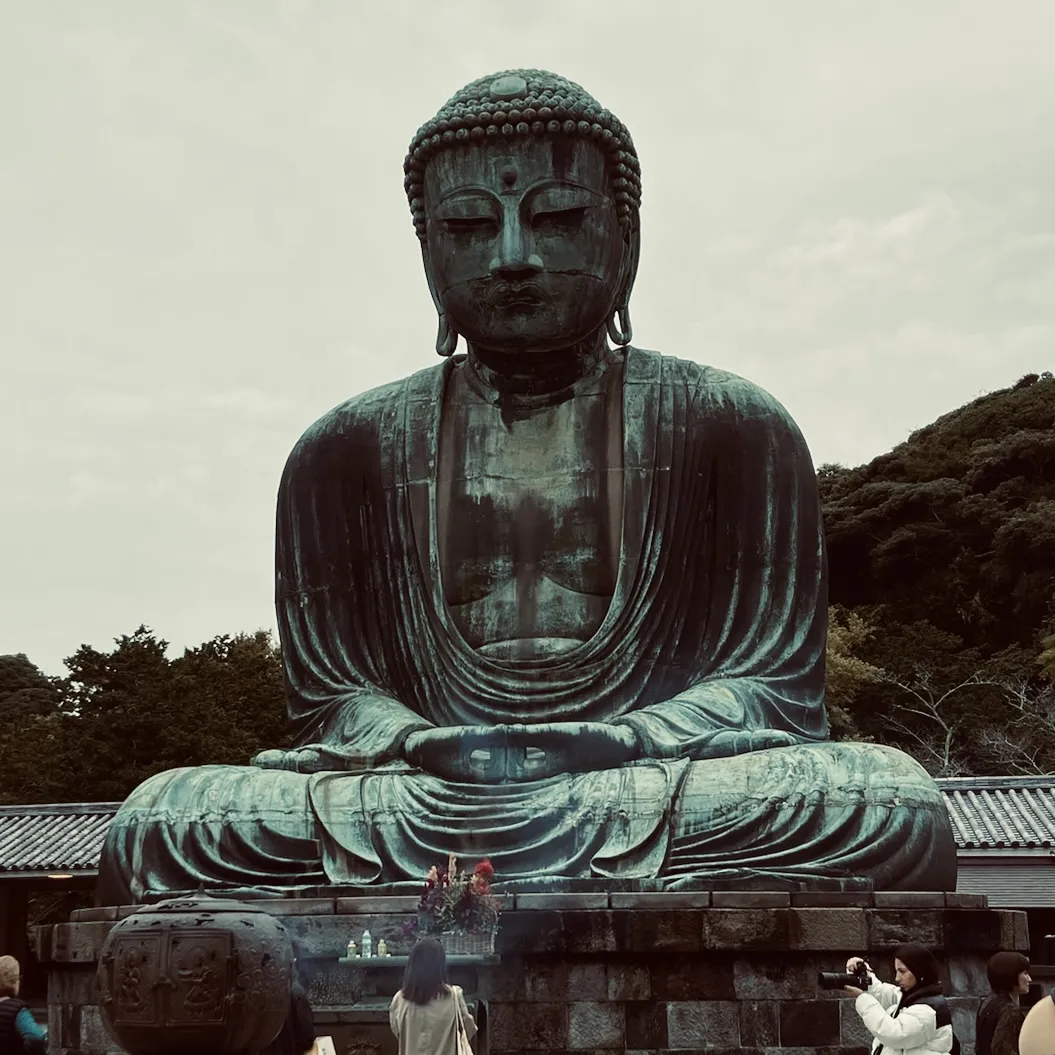
Amida Nyorai at Kōtoku-in, Kamakura. October 2024.
I don’t know why, but I woke up thinking about karma.
Maybe it’s the persistent pain in my gut and the other worrying symptoms. Puts me in an almost wistful mood; leads me to consider the big questions.
Karma is one of the more misunderstood Buddhist concepts in the West. It’s no surprise. The Judeo-Christian paradigm is deeply entrenched. It’s the air we breathe, whether or not we believe in it. It shapes our epistemic frameworks in critical (and, I’d argue, insidious) ways.
Thus, karma tends to be treated like the scales of justice, only on a cosmic scale. We impose rigid dichotomies of right and wrong. It can have nasty consequences, like blaming cancer patients for their own illnesses. You must have done something terrible in a past life.
The fundamental idea behind karma is incredibly simple. It is not some form of justice administered by a capricious deity or an intelligent universe. It is an impersonal causal process. Even more plainly stated, it concerns the causes and effects of intentional action.
When someone acts out of hatred, they reinforce the conditions that perpetuate hatred. When someone acts compassionately, they cultivate conditions more conducive to awakening.
But we have to take the moralizing tendency out of the equation. There is no guarantee that a terrible person will experience some satisfying comeuppance. Buddhism is not concerned with vindicating our sense of justice. This isn’t a cosmic bank account, a system of credits and debits for merits and demerits.
Another consideration is scale. We tend to look at this life as the be-all and end-all. Buddhism thinks in terms of kalpas. The fruits of our actions could ripen many eons from now. Who knows?
Anyway, that’s all probably clear as mud, but I gave it a shot. As I reflected on the topic, I realized how often I still find myself viewing karma incorrectly, even after so many years of study.
It’s one of the many reasons I’m so drawn to the Jōdo Shū tradition. A foundational idea is the recognition that we are bonbu (凡夫) — ordinary, deluded beings burdened by karmic conditioning and blind passions. The tradition emphasizes the limitations of our ability to liberate ourselves through our own efforts.
I’ve been here many times before and would be again, given my inability to adequately practice the Dharma. But through the Nembutsu and reliance on Amida’s Primal Vow, an end to the cycle is possible.
This is a profoundly compassionate departure from the notion that awakening is something we must earn through moral perfection.
I don’t know about any of you, but even an infinite number of lifetimes wouldn’t be enough for me to approach anything resembling perfection.
Of course, everything I’ve written is very superficial. There are layers, many of which are beyond my understanding. But I turn to Hōnen’s One-Sheet Testament (Ichimai Kishōmon):
一文不知の愚鈍の身になして
Ichimon fuchi no gudon no mi ni nashite.
Literally, becoming a foolish person who knows not a single written character.
In other words, mastery of doctrine is not a prerequisite for liberation. Just recite the Nembutsu.